Technical Research Archive V8 Supercars
Cars / Group 3A / EB I Falcon
Ford · Group 3A

EB I Falcon

1993 · 23/41 specifications catalogued

The Ford EB Falcon in its original 1993 form (EB I) was the shape the Falcon raced in the first season of the Group 3A 5.0-litre V8 formula, before the 1994 canard upgrade that became the EB II.

The 1993 aero state
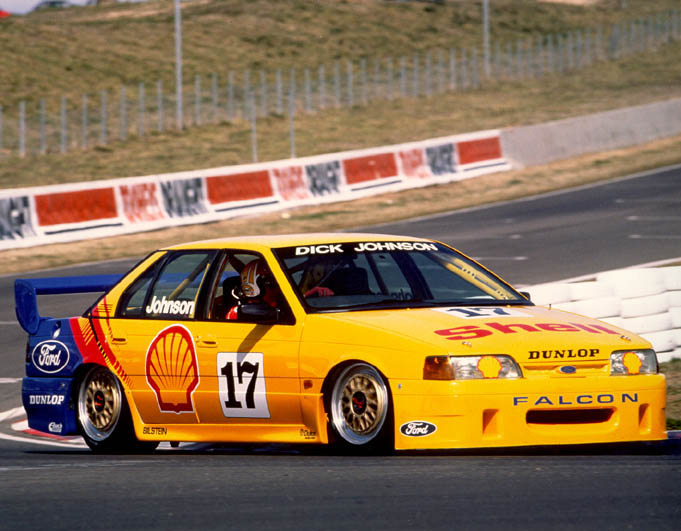
The DJR EB Falcon aerodynamic package, seen here at the Bathurst Media Day, 1992
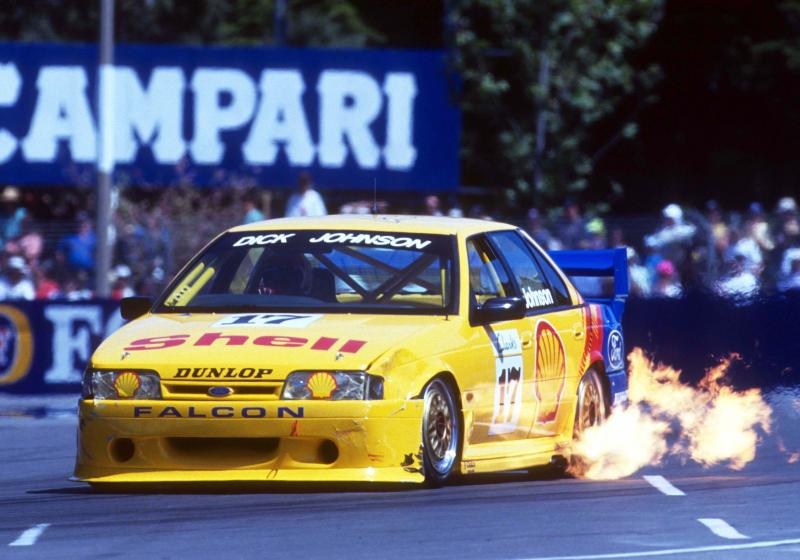
The Final Front End (the Glenn Seton Racing derived package), seen at the Australian Grand Prix Non Champ event, Late 1992

EB I ran a very simple front end: a front spoiler with a full-width undertray spanning the whole front underside and, crucially, no canards. the front bar that was approved for use in 1993 and onwards, was a mix of the EB GTO road bar with a few added lips, and several front-bar versions were reportedly trialed, with option from both Glenn Seton Racing and Dick Johnson Racing being trialed before one was settled on, the final bar being the Glenn Seton Racing designed option. The absence of front canards, along with the thinner rear wing are the defining differences from the EB II, which added canards/winglets from 1994; every privateer main-series EB from 1994 onward used the EB II aerodynamic package.

Group 3A engine & driveline

Under the skin the EB set the template for the whole "E-series": a naturally aspirated Ford 5.0-litre Windsor-based V8, revving to the regulated 7500 rpm with a 10:1 compression ceiling for roughly 580 hp in 1993. Fuel injection was standard from 1993 — the one notable exception being the Moffat Cenovis EB, which ran a Holman & Moody carburetor in 1993 before switching to EFI in 1994. Drive went through a Holinger H6S six-speed in the works cars (some privateers used a five-speed Getrag) to a Ford nine-inch live rear axle with a fabricated, fixed-ratio crown wheel and pinion. Suspension was a double-wishbone front and a live rear axle on locating links. Category minimum weight was 1300 kg.

Brakes, wheels & tyres

1993 was open-tyre competition — Dunlop, Yokohama, Bridgestone and Hoosier all ran, years before the 1999 control tyre. Brakes were ventilated discs with multi-piston calipers, the make varying by team, and wheels were team-specific custom items rather than a single control fitment (See table below (WIP)).

*For its championship record see the 1993 season. Sources: EB model-state records

  • the Group 3A frozen 5.0L formula and the verified spec catalog / V8 Supercars Physics Handbook (N. Higginson) — Grade C/D.*

Technical specification

Grouped by system. Every value carries its confidence grade and source.

confirmedperiod-verifiedbridge refunknownquarantined

Category 1/2

Formula designation
Group 3A - 5.0L V8 Touring Car (V8 Supercar) period-verified
Category formula designation (era-based)
Series & administration
unknown

Engine 7/8

Displacement
5.0 L confirmed
Div C Technical Rules (2003, harvested): max engine capacity 5000cc; formula continuous from the period ; CAMS Manual of Motor Sport, Group 3A / 5.0L Touring Car technical regs (period 1993-2001; physical Manuals, confirmed by N. Higginson 2026-08) · 5000 cc max period-confirmed across 1993-2001 by the CAMS Manuals (Group 3A regs), continuous into 2002 - no longer only the 2003 bridge.
Configuration
90-degree V8 period-verified
Group 3A formula
Induction⚑ variants
Naturally aspirated; fuel injection standard from 1993 period-verified
V8 Sleuth, Privateer EB Falcon Being Brought Back to Life ; CAMS Manual (NA only; no water injection; no moveable induction device; carb/EFI unrestricted) · Exception: the 1993 Moffat Cenovis EB ran a Holman & Moody carburettor before switching to EFI in 1994 Not universal: Moffat's Cenovis EB and Willmington GWR193 ran carburettors at the 1993 Bathurst 1000. CAMS Manual (Grade A, BLANKET rule 1993-2002): engine must be NATURALLY ASPIRATED (forced induction prohibited); water injection prohibited; NO device may alter the manifold/induction/exhaust configuration while the engine runs (moveable inlet rams / variable-length trumpets banned - FIXED trumpets are legal). Induction TYPE was NOT restricted in 1993 - the Manual does not mandate EFI or ban carburettors, so both were legal (the 1993 Moffat Cenovis carburettor was legal); EFI became the universal team choice, reflected in the 2002 Div C approved-injector list.
Power (est.)
~550 bhp (410 kW) @ 7500 rpm; ~450 ft-lb (607 Nm) torque (1993) period-verified
Shannons Club Racing Garage - EB/VP feature ("primarily US-sourced Ford and Chevrolet engines, 5.0L/302cid, 7500rpm, 10:1") · US-sourced Ford Windsor V8 (EB); 5.0L/302cid formula.
Max engine speed
7500 (regulated limit) rpm confirmed
Div C Technical Rules C 6.6.1 (2003, harvested): controlled 7500 rpm limit ; CAMS Manual of Motor Sport, Group 3A / 5.0L Touring Car technical regs (period; physical Manuals held by N. Higginson, read 2026-08) · 7500 rpm rev limit period-confirmed across 1993-2002 (CAMS Manuals, Grade A) - no longer only the 2003 bridge.
Compression ratio
10:1 confirmed
Div C Technical Rules C 6.2.1 (2003, harvested): compression ratio must not exceed 10.0:1; V8 Supercars Physics Handbook (N. Higginson) ; CAMS Manual of Motor Sport, Group 3A / 5.0L Touring Car technical regs (period 1993-2001; physical Manuals, confirmed by N. Higginson 2026-08) · 10:1 max compression period-confirmed across the CAMS Manual era (1993-2001).
Engine management
unknown
CAMS Manual (engine management free, no control ECU pre-2003) · Engine management was FREE - NO control ECU (CAMS Manual, Grade A; free from 1993). Team choice (MoTeC, Autronic, etc.) - which is why teams ran different ECUs; the TEGA control ECU only came in 2003. So an ECU value here is the team's chosen unit, not a mandated one. Driver AIDS BANNED (CAMS Manual, Grade A, blanket 1993-2002): traction control, ABS, launch control and active suspension are all PROHIBITED - model these cars with NO electronic driver aids.
Engine block
Ford 5.0-litre V8 period-verified
1993 ATCC research (Wikipedia; Supercars.com; Shannons Club) | Autosport The Nostalgia Forum / Technical Forum 'V8 Supercar Engines' (topic 95363), incl. motorsport historian Ray Bell (Grade C, named-source forum history) · Ford raced a purpose-built race block, not the road crate motor: for the 1993 launch Ford successfully applied to run the Ford Motorsport (SVO) block - thicker main webbing and 4-bolt caps - because the standard Falcon crate V8 was not suited to durable race tuning; Windsor-family architecture (302/351W). This SVO race block is the direct ancestor of the later BA-onward 'Yates'/D3 head development (the D3 NASCAR-derived head was developed by Ford engineer Mose Nowland). Not uniform: budget/privateer EBs ran carburetted engines (Willmington GWR193; Moffat Cenovis Holman & Moody) with wet sump, while front-runners used EFI. Injection/sump/spec varied by entrant.

Drivetrain 4/4

Holinger H6S 6-speed; 5-speed Getrag in some privateer cars in the early days (1993-94) period-verified
V8 Supercars Physics Handbook (N. Higginson); Holinger official history; V8 Sleuth | Div C Technical Rules 2002 (AVESCO Operations Manual, OCR of Scopsmanuals scan) C 7.2.5 (H-pattern, non-sequential change mandated) ; CAMS Manual of Motor Sport, Group 3A / 5.0L Touring Car technical regs (period; physical Manuals held by N. Higginson, read 2026-08) ; 1997 CAMS Manual (6-gear cap + H-pattern) · The Getrag 5-speed was an early-days privateer gearbox (1993-94); all cars ran the H6S from 1995. In period the gearbox was H-pattern (non-sequential): 2002 Div C C 7.2.5 mandated an 'H'-pattern change with a non-sequential mechanical linkage; sequential/electronic-assisted selection was prohibited (sequential shift came to the category later). Gearbox varied by ENTRANT, not by model: the professional teams ran the 6-speed Holinger H6S (H-pattern), but budget/privateer cars ran 5-speed boxes - Getrag 265-based (Willmington GWR193 EB, Moffat Cenovis EB, both carburetted) and the Holinger GRA-5 'Group A 5-speed' in Group A-carryover Commodores. When 6-speed became universal pre-2003 is unconfirmed. CAMS Manual (Grade A, period): H-PATTERN gearchange REQUIRED across 1993-2002 (sequential prohibited the whole era). [Max gear-count not yet extracted - N. gave the H-pattern rule but not a gears cap; TBC.] Gearbox rules (CAMS Manual, Grade A, 1993-2002): MAX 6 forward gears + H-PATTERN gearchange required (sequential banned). No MINIMUM gear count -> a 5-speed (e.g. Getrag) was LEGAL, which is why budget privateers ran them; the works 6-speed Holinger H6S was the maximum-gear choice. RESOLVES the five-speed question. 1993-94: the ENTIRE transmission was FREE - gearbox type, ratios AND final drives - the only cap being 6 forward gears + an optional reverse (1993 CAMS Manual, Grade A). The fixed homologated control GEARSET applied from 1995; the 3.25/3.5/3.7 final-drive control set is confirmed for 2002 (Div C C7.4.5).
Gear ratios
Free ratios (1993-94, CAMS Manual Grade A): teams chose their own gear ratios within the 6-gear cap + H-pattern - NO control gearset until 1995. Privateers ran 5-speed Getrags; actual per-team sets are not in the held Manuals. period-verified
1994 CAMS Manual of Motor Sport (Group 3A - free ratios, 6-gear cap, H-pattern; held by N. Higginson) · The fixed control gearset (2.571/1.989/1.665/1.351/1.138/1.000; tooth counts 14:33 etc.) came in from 1995 and is a LATER reference only - do NOT apply it to 1993-94. 1993 CAMS Manual: gearbox internals + FINAL DRIVES were also free; optional reverse; only cap = 6 forward gears.
Final-drive options
Free (1993-94, CAMS Manual Grade A): final-drive ratios were team choice - no control set (9-inch-type axle). The 3.25/3.5/3.7 circuit set is a LATER control reference (2002 Div C C7.4.5), NOT the 1993-94 rule. period-verified
1993 CAMS Manual of Motor Sport (Group 3A - transmission/final-drive free, 6-gear cap + optional reverse; held by N. Higginson) · Period-confirmed for 2002 by the official VX and AU spec pages; the same set is used in the mod gearbox files (Simulator notes)
Differential
9-inch crown wheel & pinion (fabricated assembly, fixed ratios) period-verified
2002 V8Supercars.com VX & AU specs (FND-037); 2004 AVESCO specs · Period-confirmed 2002; early Commodores used a Ford F100 truck 9-inch diff housing

Suspension 3/8

Front type
unknown
Rear type
unknown
Front spring rate
78.8-175.1 (400/500-900/1000 lb; circuit-dependent) N/mm period-verified
Jack Perkins, Perkins Engineering · Real figures are in pounds (Perkins); N/mm shown for engineering use
Rear spring rate
40.3-87.6 (230-500 lb; circuit-dependent) N/mm period-verified
Jack Perkins, Perkins Engineering
Anti-roll bars
Cockpit-adjustable from 1994; 2nd blade ~1999-2000; both blades 2008 period-verified
Jack Perkins, Perkins Engineering · 2008 is post-period
Dampers
unknown
Front geometry
unknown
Rear geometry
unknown

Brakes 1/5

Front disc
unknown
Rear disc
unknown
Front caliper⚑ variants
unknown
Rear caliper
unknown
Brake pads
Ferodo DS3000 (Perkins Engineering) period-verified
V8 Supercars Physics Handbook (N. Higginson) / Perkins

Wheels & tyres 3/4

Wheel size
17 x 11 in period-verified
Standard rolling stock from 1993 (Wikipedia; JAX Tyres) · Diameter/width is category-standard; wheel supplier/brand varied by team, and earlier Group 3A cars ran various custom wheels CAMS Manual (Grade A): 17-inch rim DIAMETER is category-mandated across 1993-2001; wheel width + material pending confirmation. 1994-2002 CAMS Manuals (Grade A, confirmed 1994/1997 + 2002 Div C) wheel envelope: max COMPLETE-wheel (rim+tyre) WIDTH = 12 in (~305 mm, = the 2002 Div C 305 mm limit); max rim diameter 17 in; max complete-wheel diameter 680 mm. Wheel MATERIAL is NOT restricted in the 1997 Manual (magnesium permitted - matches the Speedline/O.Z. magnesium wheels used). Rim width itself is a team choice within the envelope (commonly 11 in).
Tyre supplier
Open tyre competition (no control tyre) period-verified
V8 Supercars period-research compilation (Nathan/GPT, 2026) - period journalism & driver accounts; Grade C, to confirm against the 1993-2001 CAMS Manuals · Tyre history: 1993-1998 open competition (no control tyre) - 1997 per team: Bridgestone (HRT, GSR, Stone Brothers), Dunlop (DJR, Perkins), Yokohama (Gardner, Gibson, Longhurst). Bridgestone became the control tyre in 1999; Dunlop control from 2002.
Tyre dimensions
12-inch-wide tyres on 17 x 11 rims period-verified
Standard rolling stock from 1993 (Wikipedia) · CAMS Manual (Grade A): category max tyre overall diameter = 680 mm across 1993-2001. 1994-2002 CAMS Manuals (Grade A) envelope: max complete-wheel width 12 in (~305 mm) and max complete-wheel overall diameter 680 mm (all years).
Tyre construction
unknown

Weight 1/2

Minimum weight
1300 kg confirmed
V8 Supercars period-research compilation (Nathan/GPT, 2026) - period journalism & driver accounts; Grade C, to confirm against the 1993-2001 CAMS Manuals · 1300 kg initially; raised to 1350 kg from 1997. Category minimum was 1300 kg to mid-1995, raised to 1325 kg at the 1995 Bathurst 500 after Ford teams ran lightweight shells (lighter-gauge steel, thinner glass); 1350 kg by 2002, 1355 from 2004. CAMS Manual (Grade A, period; N. Higginson's held books, read 2026-08): minimum weight is BARE - WITHOUT fuel, driver or protective apparel. Category timeline: 1300 kg 1993-95, 1325 kg 1996 (PROVISIONAL - 1996 Manual not held), 1350 kg 1997-2002. CORRECTION: the 1995 Manual reads 1300 kg (start of year); 1325 first appears for 1996 - so the earlier '1325 at the 1995 Bathurst 500' framing needs the 1996 book (or a mid-1995 bulletin) to confirm exactly when it changed.
Weight distribution
unknown

Fuel 1/2

Fuel capacity
120 L confirmed
Div C Technical Rules (2003, harvested): fuel tank max 115 L, TEGA checking vessel 120 L; 2000 cost page; V8 Supercars Physics Handbook (N. Higginson) ; CAMS Manual of Motor Sport, Group 3A / 5.0L Touring Car technical regs (period; physical Manuals held by N. Higginson, read 2026-08) · 120 L MAXIMUM tank capacity, period-confirmed across 1993-2002 (CAMS Manuals, Grade A).
Fuel specification
unknown

Dimensions 0/3

Wheelbase
unknown
Front track
unknown
Rear track
unknown

Aerodynamics 2/3

Front aero⚑ variants
EB I front: full-width undertray, no canards (original 1993 package) period-verified
1994 research (V8 Sleuth; Supercars.com; Wikipedia) | Shannons Club Racing Garage (EB SS / EF-EL / AU Falcon features) ; 1993 CAMS Manual of Motor Sport (Group 3A; held by N. Higginson) · The 1993 original; superseded by EB II from 1994 1993 EB I spec: a large front spoiler/air-dam with an inverted-wing under-tray, mandated largely on safety grounds and identical (homologated) across all Fords - and crucially NO front canards. 1993 CAMS Manual (Grade A): base aero is 'as homologated'; aero DEVICES fitted to the front bar may not extend more than 65 mm at any measured point.
Rear wing
Mandated: large boot-mounted rear wing period-verified
Group 3A rules (Wikipedia) | Shannons Club Racing Garage (EB SS / EF-EL / AU Falcon features) ; 1993 CAMS Manual of Motor Sport (Group 3A; held by N. Higginson) · Large mandated boot-mounted rear wing (a homologated part, identical across all Fords). 1993 CAMS Manual (Grade A): the rear wing must be contained within the ORIGINAL BODYWORK in plan view (from above); its lateral projection incl. endplates must fit within a 260 mm (26 cm) square at any point; non-aero mountings may extend below but must stay within the device's plan-view perimeter. External decorative strips <25 mm vertical height may be removed.
Downforce / drag map
unknown

Variants & divergences

The specification above is the selected reference package. In the Group 3A era the body model did not determine the mechanical spec — individual chassis and entrants diverged. Graded leads, to be firmed up against homologation papers and the annual CAMS Manuals.

Chassis & entrant packages 3
Getrag / carburettor privateer package budget privateers 1993 Grade C
Budget EBs diverged sharply from the works EFI + 6-speed Holinger norm: a 5-speed Getrag 265 (probably with Holinger's homologated GS synchromesh gearset - probable, not confirmed), a carburetted Ford V8, wet sump, analogue gauges and (GWR193) ex-TWR Jaguar brake calipers. Induction/sump/gearbox varied by entrant.
e.g. Playscape PSR1 (Auckland-built, first privateer Falcon)
Gearbox
Getrag 265 5-speed (probable Holinger GS internals)C
Induction
Carburettor, wet sumpC
Front caliper
ex-TWR Jaguar calipers (GWR193)D
GWR193 1993 carburetted wet-sump five-speed package Garry Willmington Racing 1993 Grade B/C
1993 (EB I) state of GWR193: a CARBURETTED Ford V8, wet-sump lubrication and a five-speed Getrag - vs the leading Ford teams' injected, dry-sump, 6-speed Holinger package. Injected from 1994 (see the EB II GWR193 card). Carburettor, block, heads, Getrag model and ratios unresolved.
e.g. GWR193 - Willmington / Pate / Watkinson, 1993 Bathurst 1000
Induction
Carburettor-fed Ford V8 (carb/manifold unresolved)B/C
Gearbox
Five-speed Getrag (model/ratios unresolved)B/C
Moffat Cenovis 1993 carburetted five-speed package Allan Moffat Racing 1993 Grade B/C
The Cenovis Falcon debuted with a Holman & Moody-built CARBURETTED Ford V8 and five-speed Getrag - vs the works injected 6-speed package. The carburetted engine was used only in 1993; a DJR-sourced injected engine replaced it for 1994. Getrag model/ratios unresolved.
e.g. AMR01 - Andrew Miedecke / Charlie O'Brien, 1993 Bathurst 1000
Induction
Holman & Moody carburetted Ford V8B
Gearbox
Five-speed Getrag (model/ratios unresolved)B/C
Regulatory & category states 1
1993 open tyre-war - team allocations 1993 Grade C
No control tyre in 1993; brands split by team. Shell Dick Johnson Racing: Dunlop. Peter Jackson / Glenn Seton Racing: Bridgestone.
e.g. Dunlop (DJR) · Bridgestone (Peter Jackson / GSR)
Quarantine & disputes 2
DJR legal 1993 construction boundary Dick Johnson Racing 1992-93 Grade C
QUARANTINE. DJR EB2 and EB3 were the legal 1993 race cars; the earlier EB1 prototype was rejected for tubbed inner wheel wells and a solid engine-mounting system that made the engine a stressed structural member (period Adelaide GP disputes also cited homologation date, rear bumper, aero kit). EB1 dimensions/construction/engine installation are quarantined - do not apply them to the EB I reference package.
DJR pre-race front-aero development states Dick Johnson Racing 1992-early 93 dev Grade E
QUARANTINE. Period magazine images show at least three pre-competition front treatments (an EA-GT-like bar with an added flat tray; a later development air dam; then a competition design). Useful for quarantining development photos - not homologation evidence.
Front aero
Multiple pre-race development designs - NOT race specificationE